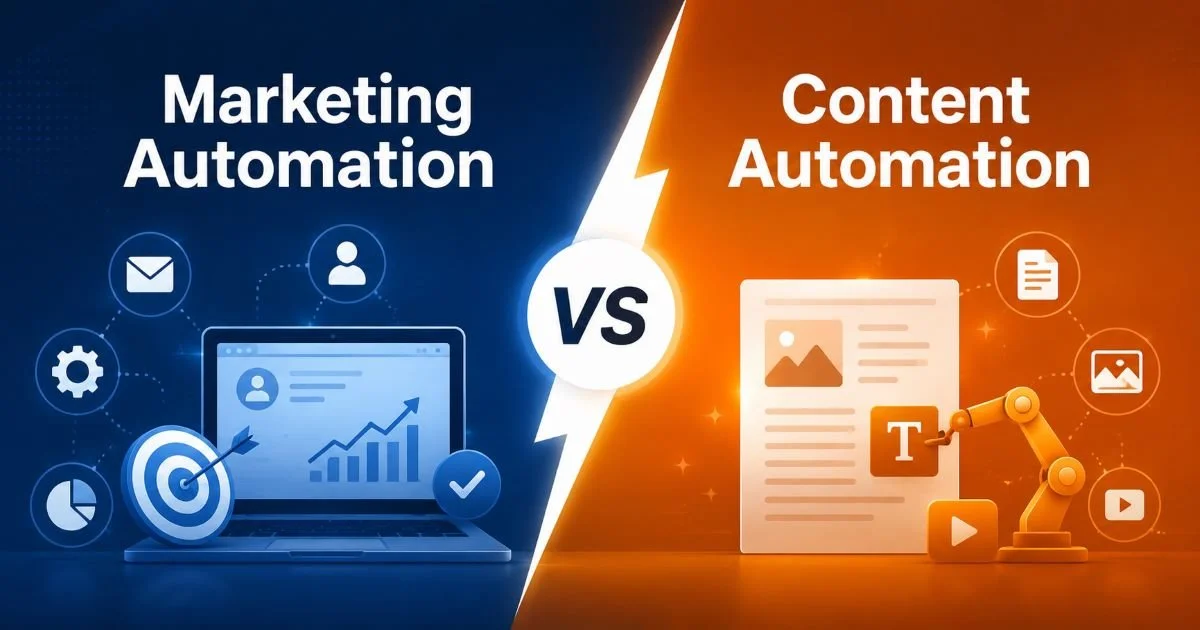
Marketing automation vs content automation explained is a question that comes up frequently among digital marketers trying to streamline their operations. Both approaches promise efficiency, reduced manual labor, and better results. But they target different parts of the marketing ecosystem, and confusing one for the other can lead to wasted budgets and misaligned strategies.
Marketing automation focuses on orchestrating customer journeys, lead nurturing, and campaign execution. Content automation zeroes in on the creation, management, and distribution of content itself. Understanding where these two disciplines overlap, and where they diverge, helps you invest in the right tools for your specific goals.
If you want a broader primer on how these concepts connect, our complete guide to content marketing automation breaks down the full picture.
Key Takeaways
- Marketing automation manages leads, campaigns, and customer journeys at scale.
- Content automation handles creation, repurposing, scheduling, and publishing workflows.
- Most teams benefit from combining both rather than choosing only one.
- AI tools have blurred the boundary between these two categories significantly.
- Your choice depends on whether your bottleneck is distribution or production.
What Each Term Actually Means
Marketing Automation Defined
Marketing automation refers to software platforms that manage repetitive marketing tasks across channels. Think email drip campaigns, lead scoring models, CRM integrations, and triggered workflows based on user behavior. Platforms like HubSpot, Marketo, and ActiveCampaign are the classic examples. The core purpose is moving prospects through a funnel without requiring a human to manually send each message or update each record.
These systems excel at personalization at scale. When a prospect downloads a whitepaper, marketing automation can trigger a follow-up email sequence, assign a lead score, and notify a sales rep if the score crosses a threshold. The emphasis is on orchestration: getting the right message to the right person at the right time. It is fundamentally about managing relationships with audiences you have already captured.
The data backbone is what makes marketing automation powerful. Behavioral tracking, A/B testing, and conversion analytics feed back into the system so campaigns improve over time. Without content to deliver, though, these platforms are empty pipelines. That is where the other side of this comparison becomes relevant.
Content Automation Defined
Content automation covers the tools and processes that accelerate how content gets planned, created, repurposed, and published. This includes AI writing assistants, automated social media schedulers, content workflow platforms, and tools that transform a single blog post into dozens of derivative assets. The focus is on production velocity and consistency rather than lead management.
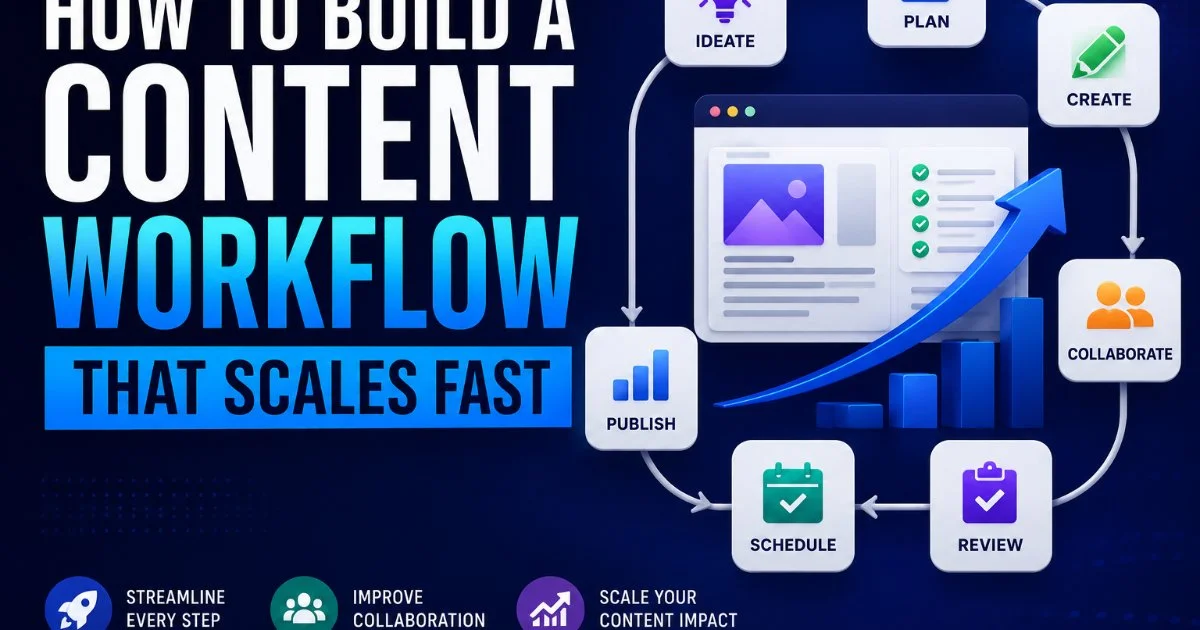
A solid content workflow might start with keyword research, move through drafting and editing stages, and end with multi-channel distribution. When you build a content workflow that scales fast, automation handles the bottlenecks between each step. AI tools can now generate first drafts, suggest headlines, create social snippets, and even add AI narration to videos automatically, turning one piece into many formats.
Content repurposing is one of the most valuable applications here. A single long-form article can become an email newsletter, a LinkedIn carousel, a podcast script, and a short video. Teams that master content repurposing strategies to maximize ROI consistently outperform those who create each asset from scratch. The efficiency gains compound quickly.
Start by automating your most repetitive content task first, such as social media reformatting, before tackling full production pipelines.
Marketing Automation vs Content Automation Explained: Head-to-Head
Comparing these two categories side by side reveals how different their priorities really are. Marketing automation is buyer-centric, designed around who receives your messaging. Content automation is asset-centric, designed around what you produce and how efficiently you produce it. Both use AI and both save time, but the problems they solve sit at different points in the marketing lifecycle.
The cost profiles differ substantially as well. Marketing automation platforms like Marketo or Pardot often run thousands of dollars per month, especially for large contact databases. Content automation tools tend to be more modular, with many AI content tools priced per seat or per usage tier. Teams evaluating top AI content tools for marketing teams often find they can start small and scale incrementally, which appeals to budget-conscious organizations.
Implementation timelines also vary. A full marketing automation deployment, including CRM integration, lead scoring rules, and multi-step email workflows, can take weeks or months to configure properly. Content automation tools typically have shorter ramp-up periods because the inputs (topics, brand guidelines, templates) are less technically complex than behavioral trigger logic.
The skill sets required reflect these differences. Marketing automation demands knowledge of funnel strategy, segmentation, and data hygiene. Content automation requires editorial judgment, brand voice consistency, and an understanding of how different formats perform on different channels. Some team members will bridge both worlds, but the day-to-day work looks quite different.
Where They Overlap and Diverge
Shared Ground
Both marketing automation and content automation rely heavily on AI in 2024 and beyond. Natural language processing powers email subject line optimization on the marketing side and draft generation on the content side. Machine learning drives predictive send-time optimization in marketing platforms and content performance forecasting in publishing tools. The technology underneath is converging even as the applications remain distinct.
Both categories also require strong data inputs to function well. Marketing automation needs clean contact data, accurate behavioral tracking, and well-defined segments. Content automation needs performance analytics, keyword data, and audience preference signals. Poor data quality undermines either system. Interestingly, some large language models now used even in home assistant contexts share the same foundational AI architecture that powers both marketing and content automation platforms.
"The real power emerges when content automation feeds marketing automation with a steady stream of high-quality, targeted assets."
Key Differences in Practice
The most practical difference comes down to output type. Marketing automation outputs are actions: emails sent, leads scored, workflows triggered, audiences segmented. Content automation outputs are assets: blog posts, social updates, videos, newsletters, ad copy. One system decides when and to whom; the other decides what and in which format.
Measurement differs too. Marketing automation success is measured in conversion rates, pipeline velocity, and revenue attribution. Content automation success is measured in production volume, time-to-publish, content quality scores, and engagement metrics across channels. A team might produce fifty pieces of content per month (content automation win) but fail to convert any readers (marketing automation gap), or vice versa.
| Dimension | Marketing Automation | Content Automation |
|---|---|---|
| Primary Goal | Nurture leads, drive conversions | Create and distribute content faster |
| Key Metrics | Conversion rate, MQLs, revenue | Volume, engagement, time-to-publish |
| Typical Tools | HubSpot, Marketo, ActiveCampaign | Jasper, ContentAutomation, Buffer |
| AI Application | Predictive scoring, send optimization | Draft generation, repurposing, scheduling |
| Setup Complexity | High (CRM integration, workflows) | Moderate (templates, brand rules) |
| Cost Range | $800 to $3,000+ per month | $50 to $500+ per month |
| Best For | Sales-driven organizations | Content-heavy brands and publishers |
Many enterprise platforms now bundle both capabilities, but bundled features rarely match the depth of dedicated tools in either category.
Choosing the Right Approach for Your Team
When Marketing Automation Wins
If your primary challenge is converting existing traffic and leads into customers, marketing automation deserves your budget first. Companies with established content libraries but poor nurturing sequences leave money on the table every day. The infrastructure to score leads, trigger personalized follow-ups, and hand off qualified prospects to sales can transform revenue outcomes without producing a single new blog post.
B2B companies with longer sales cycles benefit disproportionately from marketing automation. When a buying decision involves multiple stakeholders and takes three to six months, automated nurture sequences keep your brand relevant throughout that process. The alternative, manual outreach at every stage, simply does not scale. If your sales team constantly complains about lead quality, that is a marketing automation problem more than a content problem.
Audit your existing lead nurturing sequences quarterly. Even well-built automation degrades as market conditions and audience preferences shift.
When Content Automation Wins
If your bottleneck is producing enough quality content to fuel demand generation, content automation should be your starting point. Many teams have sophisticated distribution systems but starve them of fresh material. A content automation platform that helps you go from idea to published asset in hours instead of weeks directly impacts how much pipeline your marketing engine can generate.
Read also How to Write Facebook Ad Copy That Converts Fast
This is especially true for teams practicing multi-channel marketing. When you need blog posts, social content, email copy, video scripts, and ad variations, the production demands grow exponentially. Content automation tools that handle repurposing can turn one core asset into ten derivative pieces, multiplying your reach without multiplying your headcount. For digital marketers and content creators juggling multiple formats, this efficiency is where the biggest time savings appear.
The best answer for most organizations, frankly, is both. Marketing automation vs content automation explained in practical terms is not an either-or decision but a sequencing question. Start with whichever addresses your most painful bottleneck, then layer the other on top. A content workflow that feeds perfectly formatted assets into a marketing automation platform creates a virtuous cycle where production and distribution amplify each other continuously.
Avoid investing in marketing automation before you have enough content to power your workflows. Empty nurture sequences damage brand perception more than having no automation at all.
Frequently Asked Questions
?How do I know if my bottleneck is distribution or production?
?Can HubSpot or Marketo handle content automation too?
?Does combining both tools double the cost and complexity?
?Is it a mistake to assume AI tools replace marketing automation platforms?
Final Thoughts
Marketing automation and content automation serve complementary but distinct functions. One manages the relationship layer; the other powers the production engine. When marketing automation vs content automation explained clearly, the decision becomes less about picking a winner and more about identifying your current weak link.
Invest where the friction is highest, then connect both systems so they reinforce each other. That connected approach is what separates teams that merely keep up from those that consistently outperform.
Disclaimer: Portions of this content may have been generated using AI tools to enhance clarity and brevity. While reviewed by a human, independent verification is encouraged.