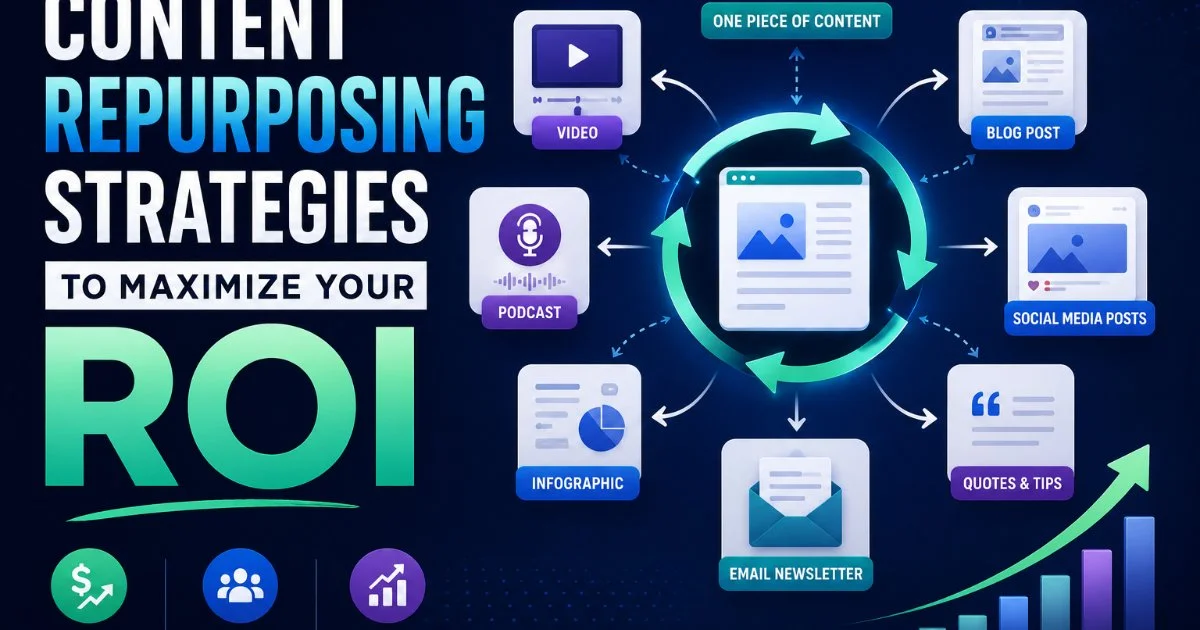
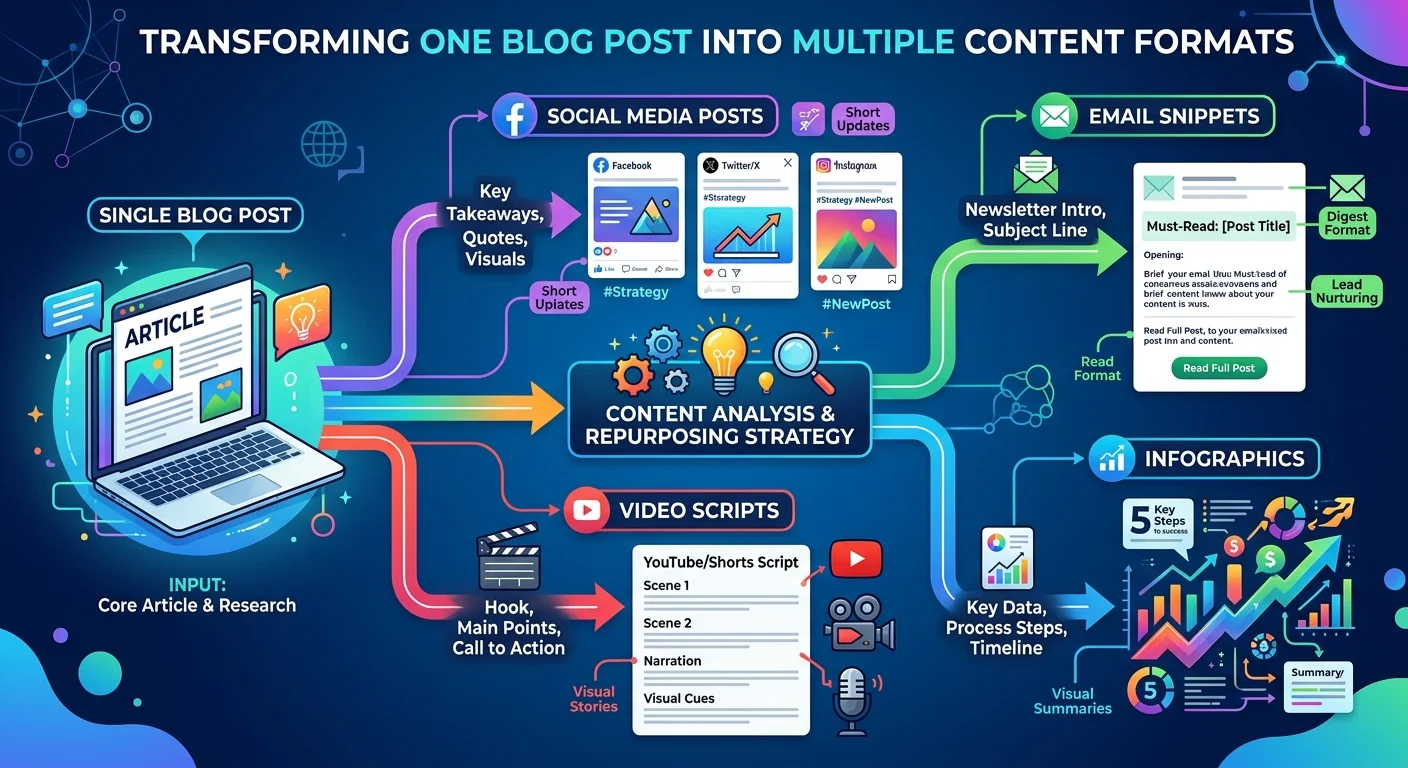
Content repurposing strategies to maximize your ROI represent one of the most efficient ways to extract more value from every piece you create. Most marketing teams spend 60% or more of their time producing original content, yet only a fraction of that material reaches its full potential audience. A single blog post can become a podcast episode, an infographic, a LinkedIn carousel, a newsletter segment, and a dozen social media posts.
The problem isn't a lack of ideas; it's a lack of systems. When you build a structured approach to repurposing, you reduce production costs, expand your reach across channels, and compound your results over time.
Digital marketers and content creators who master this discipline consistently outperform competitors who treat every piece as a one-and-done effort. This guide walks you through four actionable steps to build a content repurposing engine that drives measurable returns, supported by content marketing automation principles that make the process sustainable at scale.
Key Takeaways
- Repurposing one pillar asset into 8 to 12 derivative pieces dramatically lowers your cost per impression.
- Audit existing content quarterly to identify high-performing candidates worth reformatting for new channels.
- AI content tools can cut repurposing production time by 40% or more when used strategically.
- Match each repurposed format to the platform where your target audience actually engages.
- Track performance per derivative piece, not just the original, to measure true repurposing ROI.
Step 1: Audit Your Existing Content Library for Repurposing Candidates
Identify Top Performers
Before creating anything new, look at what you already have. Pull analytics from the last 12 months and sort your content by organic traffic, social shares, conversion rate, and time on page. The pieces sitting in the top 20% by any of these metrics are your strongest repurposing candidates. These are proven assets; your audience has already voted with their attention.
Don't limit your audit to blog posts. Webinar recordings, customer case studies, whitepapers, and even internal training documents often contain gold. A 45-minute webinar might hold enough material for three short video clips, two blog posts, and a week's worth of social content. The goal is to catalog everything with repurposing potential, then rank each item by its likely ROI based on past performance data.
Categorize by Format Potential
Once you've identified your top performers, assess each piece for format flexibility. Long-form written content adapts well to audio scripts, slide decks, and social threads. Data-heavy content converts naturally into infographics or chart-based social posts. Interviews and Q&A content can be sliced into short video clips or quote graphics. Not every piece translates equally well into every format, so be selective about matches.
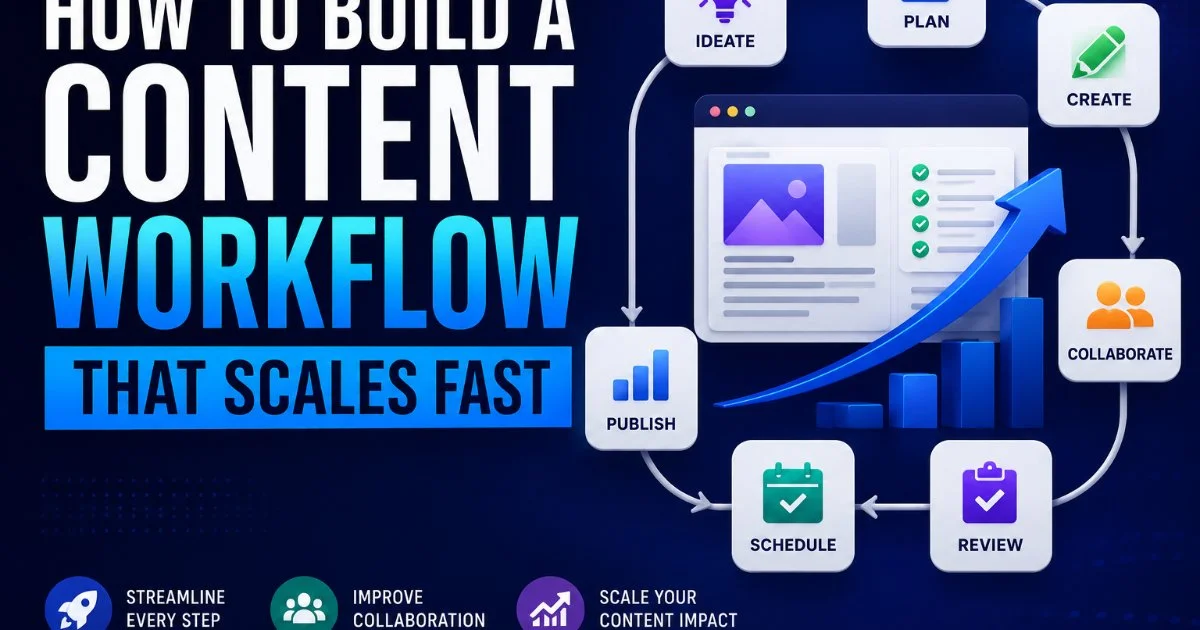
Create a simple spreadsheet with columns for the original asset, its performance metrics, and three to five potential derivative formats. This becomes your repurposing backlog, similar to how a development team manages a product backlog. If you need a system for organizing this pipeline, understanding how to build a content workflow that scales fast gives you the operational foundation to manage this process without drowning in complexity.
Tag each content piece in your CMS with "repurpose-ready" and its target formats so your team can spot opportunities at a glance.
Step 2: Map Content Repurposing Strategies to Maximize Your ROI Across Channels
Build a Platform-Format Matrix
Each platform rewards different content types. LinkedIn favors text-based carousels and document posts. Instagram thrives on short-form video and static carousels. YouTube rewards longer educational videos. Email newsletters perform best with concise, scannable summaries that link to deeper resources. Your content repurposing strategies to maximize your ROI must account for these differences, or you'll waste effort pushing the wrong format to the wrong audience.
| Platform | Best Repurposed Format | Ideal Length | Engagement Driver |
|---|---|---|---|
| Carousel / Text post | 1,200 words or 8-10 slides | Professional insights | |
| Reels / Carousel images | 30-60 seconds or 5-7 slides | Visual storytelling | |
| YouTube | Tutorial / Explainer video | 8-15 minutes | Search and education |
| Summary with CTA | 200-400 words | Personalization and urgency | |
| X (Twitter) | Thread / Quote graphic | 5-12 tweets | Conversational hooks |
| Podcast | Audio discussion / Interview | 15-30 minutes | Depth and personality |
Prioritize High-Impact Formats
You can't repurpose every piece into every format right away. Prioritize based on where your audience already spends time and where you see the biggest gap between effort and return. If your email list converts at 4% but your Instagram engagement is flat, allocate repurposing resources toward email-optimized summaries first. Follow the data rather than chasing trends on platforms where you don't have traction.
"The best content repurposing strategy isn't about being everywhere; it's about being strategically present where your audience converts."
Consider the production cost of each derivative format as well. Turning a blog post into a Twitter thread might take 20 minutes. Turning it into an animated explainer video could take 8 hours. Your ROI calculation must factor in both the expected reach and the labor involved. Many teams find that written derivatives (threads, newsletters, carousels) offer the best return on time, while video content, though more expensive to produce, generates stronger brand awareness over the long term.
Step 3: Automate Your Repurposing Workflow with AI Tools
Choose the Right Automation Stack
Modern AI content tools have transformed what a small team can accomplish. Tools like Jasper, Descript, and Canva's AI features can handle much of the heavy lifting in text summarization, video editing, and graphic generation. Understanding the difference between marketing automation and content automation helps you pick tools that solve the right problem. Marketing automation handles distribution and nurturing; content automation handles the creation and reformatting stages.
When selecting tools, pay attention to their API capabilities. If your stack includes custom integrations or you manage multiple content pipelines, robust API management tools become important for keeping your systems connected. The goal is to eliminate manual handoffs between creation, reformatting, and scheduling. Every manual step is a bottleneck that reduces your ROI. For a deeper look at specific tool options, reviewing top AI content tools for marketing teams can help you shortlist the right solutions.
Build a Repeatable Process
Automation without a process just speeds up chaos. Define a clear content workflow that maps each stage: original creation, derivative planning, AI-assisted reformatting, human review, and scheduled publishing. Assign ownership at each stage. One team member might handle the AI-generated drafts while another reviews and approves final assets. This division of labor prevents quality from slipping as volume increases.
Consider building templates for each derivative format. A LinkedIn carousel template, an email newsletter template, and a social post template specific to each platform will reduce decision fatigue and speed up production. When your process is documented and repeatable, you can scale repurposing from 3 to 4 derivatives per original piece up to 10 or 12 without proportionally increasing your team size. That's where the real ROI multiplication happens.
AI-generated content still requires human review. Regulations like those outlined in the EU AI Act compliance framework increasingly require transparency about AI involvement in content production.
Step 4: Measure and Optimize ROI from Every Derivative Piece
Set Up a Tracking Framework
Most teams track the performance of original content but ignore derivatives entirely. This is a major blind spot. Each repurposed piece should carry UTM parameters or unique tracking links so you can attribute traffic, leads, and conversions back to the specific format and channel. Without this granularity, you're guessing which repurposing efforts actually generate returns, and guessing is expensive.
Set up a dashboard that compares cost per lead, engagement rate, and traffic contribution across all derivative formats. This doesn't need to be complex. A Google Sheets tracker linked to your analytics platform works fine for teams under ten people. The key is consistency: update it weekly, review it monthly, and use the data to inform next quarter's repurposing priorities. Your content repurposing strategies to maximize your ROI only work if you can actually see which strategies are pulling their weight.
Iterate Based on Data
After two to three months of tracking, patterns will emerge. You might discover that LinkedIn carousels drive 3x more traffic than Twitter threads, or that email summaries of case studies convert better than summaries of how-to guides. Use these insights to reallocate effort. Double down on what works and stop spending time on formats that underperform. This iterative approach is what separates systematic content repurposing strategies to maximize your ROI from haphazard recycling.
Don't be afraid to retire formats that consistently underperform. Content repurposing is about efficiency, not completeness. If podcast clips from your blog content generate minimal downloads, redirect that time toward email sequences or video shorts that deliver measurable results. The quarterly audit you established in Step 1 feeds directly into this optimization loop, creating a cycle of continuous improvement across your entire marketing operation.
Avoid repurposing content across platforms without adapting tone and format. A blog paragraph copy-pasted as a LinkedIn post signals laziness and typically underperforms native content by 60% or more.

Frequently Asked Questions
?How do I build the spreadsheet for tracking repurposing candidates?
?Is repurposing worth it if my original content already underperforms?
?How much time does AI actually save in a repurposing workflow?
?Can a single webinar really generate enough content for multiple formats?
Final Thoughts
Content repurposing strategies to maximize your ROI aren't about working harder; they're about extracting the full value from work you've already done. Start with a thorough audit, map each piece to the right formats and platforms, automate the production steps with AI tools, and measure everything with precision.
The teams that treat repurposing as a core competency rather than an afterthought consistently generate more leads, more engagement, and more revenue per piece of content created. Build the system once, refine it continuously, and let your best content work for you across every channel your audience touches.
Disclaimer: Portions of this content may have been generated using AI tools to enhance clarity and brevity. While reviewed by a human, independent verification is encouraged.